Search

Go to
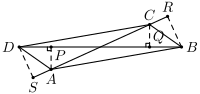
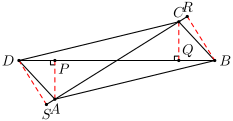
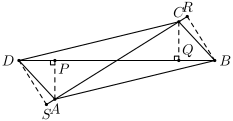 Suppose $PQ=6$ and $RS=8,$ and let $d$ denote the length of $\overline{BD},$ the longer diagonal of $ABCD.$ Then $d^2$ can be written in the form $m+n\sqrt p,$ where $m,n,$ and $p$ are positive integers and $p$ is not divisible by the square of any prime. What is $m+n+p?$ $\textbf{(A) }81 \qquad$ $ \textbf{(B) }89 \qquad$ $ \textbf{(C) }97\qquad$ $ \textbf{(D) }105 \qquad$ $ \textbf{(E) }113$