Sign in
← Exercise 152 →
Search
Go to
Exercise 152
Let $ABCD$ be a parallelogram with area $6$. Points $P,Q$ are the projections of $A,C$ onto line $BD$, and $R,S$ are the projections of $B,D$ onto line $AC$. Suppose $PQ=4$ and $RS=6$, and let $d$ denote the length of $\overline{BD}$, the longer diagonal. Then $d^2$ can be written as $m+n\sqrt p$. What is $m+n+p$?
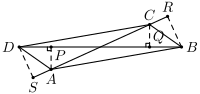
← Back to Problem 152
Solution
  1. With $OP=p_0=2$, $OR=r_0=3$: letting $OA=p_0a, OD=r_0a$, we get $AP=p_0\sqrt{a^2-1}$ and $BD=2r_0a$.
  2. $AP\cdot BD=[ABCD]$: $2p_0r_0\, a\sqrt{a^2-1}=6$, i.e. $12a\sqrt{a^2-1}=6$, so $a\sqrt{a^2-1}=\frac12$, giving $a^4-a^2-\frac14=0$.
  3. $a^2=\dfrac{1+\sqrt2}2$ (taking the positive root), so $d^2=(2r_0a)^2=36a^2=18(1+\sqrt2)=18+18\sqrt2$.
  4. $m+n+p=18+18+2=\boxed{38}$.
Search Go to Prev      Next

Contact Us

Thanks! Your message has been sent.
