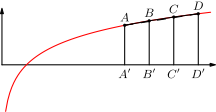
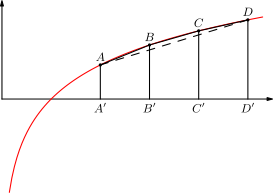
The vertices of a quadrilateral lie on the graph of $y = \ln x$, and the $x$-coordinates of these vertices are consecutive positive integers. The area of the quadrilateral is $\ln \frac{91}{90}$. What is the $x$-coordinate of the leftmost vertex? $\textbf{(A)}\ 6\qquad$ $\textbf{(B)}\ 7\qquad$ $\textbf{(C)}\ 10\qquad$ $\textbf{(D)}\ 12\qquad$ $\textbf{(E)}\ 13$
Let $A',B',C',D'$ be the projections of the vertices onto the $x$-axis. The quadrilateral is the sum of three trapezoids of width $1$ minus the big trapezoid $AA'D'D$ of width $3$: \begin{align*}[ABCD]&=\frac{\ln(n(n+1))}2+\frac{\ln((n+1)(n+2))}2+\frac{\ln((n+2)(n+3))}2\\&\qquad-3\cdot \frac{\ln(n(n+3))}2=\ln\frac{91}{90}.\end{align*}
The vertices of a quadrilateral lie on the graph of $y=\ln x$, and the $x$-coordinates of these vertices are consecutive positive integers. The area of the quadrilateral is $\ln\frac{21}{20}$. What is the $x$-coordinate of the leftmost vertex?