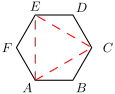
Equiangular hexagon $ABCDEF$ has side lengths $AB=CD=EF=1$ and $BC=DE=FA=r$. The area of $\triangle ACE$ is $70\%$ of the area of the hexagon. What is the sum of all possible values of $r$? $\textbf{(A)}\ \frac{4\sqrt{3}}{3} \qquad$ $ \textbf{(B)} \frac{10}{3} \qquad$ $ \textbf{(C)}\ 4 \qquad$ $ \textbf{(D)}\ \frac{17}{4} \qquad$ $ \textbf{(E)}\ 6$
Solution
$AC^2=1^2+r^2+r$, so $[ACE]=\frac{\sqrt3}4 AC^2=\frac{\sqrt3}4(1+r+r^2)$.
The hexagon is $\triangle ACE$ plus the three congruent triangles $ABC$, $CDE$, $EFA$, each with sides $1$, $r$ and included angle $120^\circ$: $[CDE]=\frac12\cdot 1\cdot r\cdot\frac{\sqrt3}2=\frac{\sqrt3}4r$.
$[ACE]=0.7\left([ACE]+3[CDE]\right)$ gives $[ACE]=7[CDE]$, i.e. $\frac{\sqrt3}4(1+r+r^2)=7\cdot \frac{\sqrt3}4r$.
$r^2-6r+1=0$, which has two positive roots, with sum $r_1+r_2=6$.
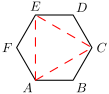
Equiangular hexagon $ABCDEF$ has side lengths $AB=CD=EF=1$ and $BC=DE=FA=r$. The area of $\triangle ACE$ is $60\%$ of the area of the hexagon. What is the sum of all possible values of $r$?