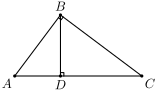
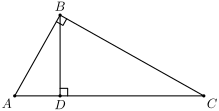
Right triangle $ABC$ has leg lengths $AB=20$ and $BC=21$. Including $\overline{AB}$ and $\overline{BC}$, how many line segments with integer length can be drawn from vertex $B$ to a point on hypotenuse $\overline{AC}$? $\textbf{(A) }5 \qquad$ $ \textbf{(B) }8 \qquad$ $ \textbf{(C) }12 \qquad$ $ \textbf{(D) }13 \qquad$ $ \textbf{(E) }15 \qquad$
Solution
$AC=\sqrt{20^2+21^2}=29$ by Pythagorean theorem.
$BD=\frac{AB\cdot BC}{AC}=\frac{20\cdot 21}{29}=14.48$ by theorem 11.
As a point moves from $D$ to $A$ along the hypotenuse, its distance from $B$ increases continuously from $BD\approx14.48$ to $BA=20$, so each of the lengths $15,16,\dots,20$ occurs exactly once: $6$ segments. As it moves from $D$ to $C$, the distance increases from $14.48$ to $21$, giving the lengths $15,16,\dots,21$: $7$ segments.
In total there are $6+7=13$ segments. The answer is (D).
Right triangle $ABC$ has leg lengths $AB=9$ and $BC=12$. Including $\overline{AB}$ and $\overline{BC}$, how many line segments with integer length can be drawn from vertex $B$ to a point on hypotenuse $\overline{AC}$?