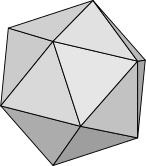
If $A$ and $B$ are vertices of a polyhedron, define the distance $d(A, B)$ to be the minimum number of edges of the polyhedron one must traverse in order to connect $A$ and $B$. For example, if $\overline{AB}$ is an edge of the polyhedron, then $d(A, B) = 1$, but if $\overline{AC}$ and $\overline{CB}$ are edges and $\overline{AB}$ is not an edge, then $d(A, B) = 2$. Let $Q$, $R$, and $S$ be randomly chosen distinct vertices of a regular icosahedron (regular polyhedron made up of 20 equilateral triangles). What is the probability that $d(Q, R) > d(R, S)$?
$\textbf{(A)}~\frac{7}{22}\qquad$ $\textbf{(B)}~\frac13\qquad$ $\textbf{(C)}~\frac38\qquad$ $\textbf{(D)}~\frac5{12}\qquad$ $\textbf{(E)}~\frac12$

