\begin{center}
\begin{asy}
dotfactor=3;
unitsize(0.9cm);
defaultpen(linewidth(0.8pt)+fontsize(10pt));
pair A=(0,0), B=(-1.8165,-0.8369), C=(-2,-2.8284), D=(2,-2.8284), E=(1.8165,-0.8369), P=(0.1835,-1.9916), Q=(-0.1835,-1.9916);
draw(A--B--C--D--E--cycle);
draw(A--P); draw(A--Q); draw(B--Q); draw(C--Q); draw(D--P); draw(E--P);
draw(A--C, dashed);
draw(A--D, dashed);
label("$A$",A,N); label("$B$",B,W); label("$E$",E,dir(0)); label("$C$",C,SW); label("$D$",D,SE);
dot(P); dot(Q);
\end{asy}
\end{center}
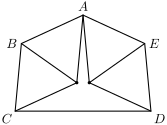
- Triangles $ABQ$ and $BCQ$ have all sides $2$, so both are equilateral, so $\angle ABC=60^\circ+60^\circ=120^\circ$, giving $[ABC]=\frac{\sqrt3}4\cdot 4=\sqrt3$ and $AC=2\sqrt3$ (by the law of cosines). By the same argument (and symmetry) on the other side, $[ADE]=\sqrt3$ and $AD=2\sqrt3$.
- $\triangle ACD$ has $AC=AD=2\sqrt3$ but now $CD=4$, so its area is $\frac{CD}4\sqrt{4AC^2-CD^2}=\frac44\sqrt{4(12)-16}=\sqrt{32}=4\sqrt2$.
- So the area is $\sqrt3+\sqrt3+4\sqrt2=2\sqrt3+4\sqrt2=\sqrt{12}+\sqrt{32}$, so $m+n=12+32=\boxed{44}$.