Sign in
← Exercise 335 →
Search
Go to
Exercise 335
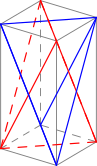
A rectangular solid measures $1\times1\times2$. Two distinct tetrahedra have all their vertices among the eight vertices of the solid, and in each tetrahedron no two vertices are joined by an edge of the solid. What is the volume of the union of the two tetrahedra?
← Back to Problem 335
Solution
  1. Color the eight vertices alternately so that vertices joined by an edge get different colors. The two tetrahedra are formed by the four vertices of each color (each contains no edge of the solid).
  2. Each tetrahedron is the solid minus four corner pieces. A corner piece at a vertex is a pyramid with mutually perpendicular edges along the solid's edges: its legs are $1,1,2$ in some order, so its volume is $\frac16\cdot1\cdot1\cdot2=\frac13$. Thus each tetrahedron has volume $2-4\cdot\frac13=\frac23$.
  3. The solid is the image of a unit cube under a stretch by a factor $2$ in one direction, which preserves intersections and face centers. For the cube, the two tetrahedra meet in the octahedron whose vertices are the face centers (as in the problem), so here the common part is the octahedron whose vertices are the centers of the six faces of the solid. It has half-diagonals $\frac12,\frac12,1$, so its volume is $\frac43\cdot\frac12\cdot\frac12\cdot1=\frac13$.
  4. The union has volume $\frac23+\frac23-\frac13=\boxed{1}$.
Search Go to Prev      Next

Contact Us

Thanks! Your message has been sent.
