Sign in
← Exercise 268 →
Search
Go to
Exercise 268
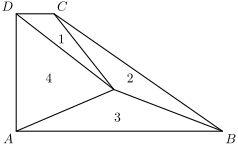
Let $ABCD$ be an isosceles trapezoid having parallel bases $\overline{AB}$ and $\overline{CD}$ with $AB>CD.$ Line segments from a point inside $ABCD$ to the vertices divide the trapezoid into four triangles whose areas are $1, 2, 3,$ and $4,$ starting with the triangle with base $\overline{CD}$ and moving clockwise. What is $\frac{AB}{CD}?$
← Back to Problem 268
Solution
  1. Let $CD=1$, $AB=r$ and $h$ the height. As in the problem, the distances from $P$ to $CD$ and $AB$ are $2\cdot1=2$ and $\frac{2\cdot3}r=\frac6r$, and the total area is $1+2+3+4=10=\frac12(1+r)\left(2+\frac6r\right)$.
  2. So $10r=(1+r)(r+3)$, i.e. $r^2-6r+3=0$, so $r=3\pm\sqrt6$; since $AB>CD$, $r=3+\sqrt6$.
  3. $\dfrac{AB}{CD}=\boxed{3+\sqrt6}$.
Search Go to Prev      Next

Contact Us

Thanks! Your message has been sent.
