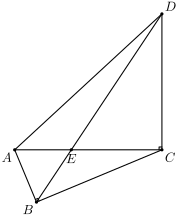
Quadrilateral $ABCD$ satisfies $\angle ABC = \angle ACD = 90^{\circ}, AC=13,$ and $CD=12.$ Diagonals $\overline{AC}$ and $\overline{BD}$ intersect at point $E,$ and $AE=5.$ What is the area of quadrilateral $ABCD?$
Set $A=(0,0)$, $C=(13,0)$, $D=(13,12)$, and $E=(5,0)$. As $\angle ABC=90^\circ$, $B$ lies on the circle with diameter $AC$, so $x_B^2+y_B^2=13x_B$. Also $B,D,E$ are collinear.
Write $B=E+t(E-D)=(5-8t,-12t)$. Substituting into the circle equation gives $26t^2+3t-5=0$. The root for which $E$ lies on segment $BD$ is $t=5/13$, giving $B=(25/13,-60/13)$.
Since $B$ and $D$ lie on opposite sides of $AC$, the quadrilateral's area is the sum of $[ABC]=\frac12(13)(60/13)=30$ and $[ACD]=\frac12(13)(12)=78$.