Sign in
← Exercise 208 →
Search
Go to
Exercise 208
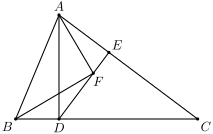
In triangle $ABC$, $AB=13$, $BC=21$, and $CA=20$. Distinct points $D$, $E$, and $F$ lie on segments $\overline{BC}$, $\overline{CA}$, and $\overline{DE}$, respectively, such that $\overline{AD}\perp\overline{BC}$, $\overline{DE}\perp\overline{AC}$, and $\overline{AF}\perp\overline{BF}$. The length of segment $\overline{DF}$ can be written as $\frac mn$, where $m$ and $n$ are relatively prime positive integers. What is $m+n$?
← Back to Problem 208
Solution
  1. Since $\angle AFB=\angle ADB=90^\circ$, the points $A,F,D,B$ lie on the circle with diameter $AB$, so $AFDB$ is cyclic and $\angle ABF=\angle ADF$. Together with $\angle AFB=\angle AED=90^\circ$ this gives $\triangle ABF\sim\triangle ADE$.
  2. In triangle $ABC$ with sides $13,21,20$, the altitude from $A$ has foot $D$ with $BD=5$, $DC=16$, $AD=12$ (check: $[ABC]=\frac12\cdot21\cdot12=126$). In the right triangle $ADC$ (right angle at $D$), $DE$ is the altitude to $AC=20$, so $DE=\dfrac{AD\cdot DC}{AC}=\dfrac{48}5$ and $AE=\dfrac{AD^2}{AC}=\dfrac{36}5$.
  3. From the similarity, $\dfrac{BF}{DE}=\dfrac{AF}{AE}=\dfrac{AB}{AD}=\dfrac{13}{12}$, so $BF=\dfrac{52}5$ and $AF=\dfrac{39}5$.
  4. Ptolemy's theorem (45) for the cyclic quadrilateral $AFDB$: $AB\cdot DF+AF\cdot BD=AD\cdot BF$, that is $13\cdot DF+\dfrac{39}5\cdot5=12\cdot\dfrac{52}5$. Hence $13\,DF=\dfrac{429}5$ and $DF=\dfrac{33}5$.
  5. So $m+n=33+5=\boxed{38}$.
Search Go to Prev      Next

Contact Us

Thanks! Your message has been sent.
