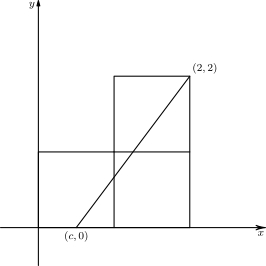
Three unit squares are arranged in the coordinate plane with lower-left corners at $(0,0)$, $(1,0)$, and $(1,1)$, forming an L-shaped region of area $3$ with its lower-left corner at the origin. The line segment from $(c,0)$ to $(2,2)$ divides the region into two parts of equal area. What is $c$?
Solution
For $y\in[0,1]$ the right-of-line region is a trapezoid with parallel sides $2-c$ (at $y=0$) and $\frac{2-c}2$ (at $y=1$, the midpoint of the segment from $(c,0)$ to $(2,2)$), so its area is $\frac12\left[(2-c)+\frac{2-c}2\right]\cdot 1=\frac34(2-c)$.
For $y\in[1,2]$ it is a trapezoid with parallel sides $\frac{2-c}2$ and $0$, area $\frac14(2-c)$.
Total right-area $=2-c$. Setting this equal to half the total area, $\frac32$: $2-c=\frac32$, so $c=\boxed{\frac12}$.
