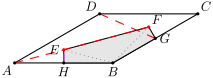
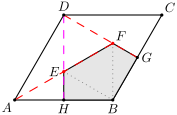
Rhombus $ABCD$ has side length $2$ and $\angle B = 120^\circ$. Region $R$ consists of all points inside the rhombus that are closer to vertex $B$ than any of the other three vertices. What is the area of $R$? $\textbf{(A)}\ \frac{\sqrt{3}}{3} \qquad$ $\textbf{(B)}\ \frac{\sqrt{3}}{2} \qquad$ $\textbf{(C)}\ \frac{2\sqrt{3}}{3} \qquad$ $\textbf{(D)}\ 1 + \frac{\sqrt{3}}{3} \qquad$ $\textbf{(E)}\ 2$
Solution
The boundary of the region closer to $B$ is made by the perpendicular bisectors of $AB$, $BC$, and $BD$. Their relevant intersections with the rhombus are $H$, $G$, $E$, and $F$, so $R$ is pentagon $EHBGF$.
Split $R$ into triangles $BHE$, $BEF$, and $BFG$. From the diagram, $BH=1$, $HE=\frac1{\sqrt3}$, $BF=\frac2{\sqrt3}$, the distance from $E$ to $BF$ is $1$, and the distance from $G$ to $BF$ is $\frac12$.
Their areas are $[BHE]=\frac{\sqrt3}{6}$, $[BEF]=\frac{\sqrt3}{3}$, and $[BFG]=\frac{\sqrt3}{6}$. Hence $[R]=\frac{2\sqrt3}{3}$.
Rhombus $ABCD$ has side length $4$ and $\angle B = 150^\circ$. Region $R$ consists of all points inside the rhombus that are closer to vertex $B$ than any of the other three vertices. What is the area of $R$?